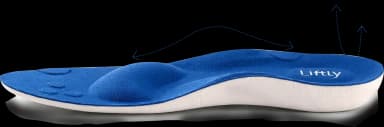
Manufacturer image · not our photo
PRODUCT REVIEW · support insoles
Liftly Review (2026): Do These Insoles Work?
Insoles sold with arch support and cushioning, designed to make long hours on your feet more comfortable.
We earn a commission if you buy through this link. It does not change the price you pay. Check the seller for current price, compatibility, and return conditions.
What is Liftly?
Liftly is an insole sold through an offer page. It is built around what the maker calls 4D Cloud Cushioning foam, plus arch support and small massage nodes across the footbed.
It is an insert, not a shoe. You place it inside shoes you already own. The maker pitches it at people who spend long hours on their feet, and frames it as a step up from plain gel or memory-foam inserts.
Liftly comes in two base size ranges. You trim them to fit your shoe, per the offer page. That is the whole idea: one insert, adjusted to your size, dropped into whatever shoes you wear most.
How Liftly is designed to work
Per the offer page, the insole is built as four zones that are meant to work together:
- a toe zone for the ball of the foot
- an arch support zone
- a lateral balance zone
- a heel zone
The maker describes the arch support as "biomechanical 3D" shaping, paired with a high-density heel cradle. The stated goal is better alignment and less strain through the foot and lower leg.
The massage nodes get their own pitch. The maker calls them gentle "micro-stimulation," meant to help keep feet from feeling numb during long shifts.
To be clear: these are the maker's design descriptions. No independent lab data is supplied here to confirm how the insole performs or whether the mechanism works as described.
What Liftly claims to help with
The offer page lists a long set of conditions Liftly is said to be designed for, including plantar fasciitis, bunions, arch pain, fallen arches, metatarsalgia, Morton's neuroma, overpronation, and heel pain.
Treat that list as marketing claims, not confirmed medical outcomes. Liftly is designed to support the foot and add cushioning. It is not a treatment, and it does not cure anything.
Also worth noting: the offer text does not cite any clinical study or trial behind these claims.
If you have ongoing or worsening foot pain, or a diagnosed condition like plantar fasciitis or bunions, talk to a doctor or podiatrist. An insole alone is not the right tool for that job.
Fit, materials, and how long they last
Liftly comes in two size ranges: Standard (37–41) and Large (42–47). You trim along dotted lines to match your shoe size, per the maker.
Setup is simple:
- Take out your shoe's original insole first. The maker says Liftly fits best without it.
- Trim along the dotted lines if needed.
- Drop the Liftly insole in and adjust.
The material is described as breathable, designed to help keep feet cool and dry and to reduce odor during wear. That is the maker's description; we have no independent testing of it here.
On durability, the maker says normal daily wear typically lasts 12 or more months. Real-world lifespan will vary. A construction worker's boots and a pair of weekend walking shoes are not the same job.
Who Liftly may be a good fit for
Based on the use cases the offer page lists, Liftly may make sense for:
- People on their feet for long stretches at work — nursing, retail, construction, and similar jobs.
- Anyone whose current shoes have little arch support or cushioning.
- People who want a trim-to-fit insole rather than paying for a custom orthotic.
- Casual athletes and walkers. The maker lists the gym, running, golf, and pickleball as intended uses.
If you stand all day and your feet feel beat up by the end of a shift, that is the situation Liftly is aimed at.
Who should skip Liftly
This product is not for everyone. Skip it if:
- You have a diagnosed foot condition and a podiatrist has prescribed a custom orthotic. An over-the-counter insert is not a replacement.
- Your foot pain is severe or getting worse. That needs a medical opinion, not a new insole.
- You want independent clinical evidence before buying. The claims on the offer page are the maker's own.
- You don't want to trim or fit an insole yourself. That step is part of the deal here.
Price, guarantee, and shipping
Price and any current discount are shown on the offer page, and they can change, so check there for the current number. We won't quote a figure here, since promotional pricing shifts.
The offer page lists a 30-day money-back guarantee if you're not satisfied. The return shipping costs and exact conditions aren't detailed there, so factor that in. A return window is helpful, but it isn't the same as a free trial — you may be out some shipping cost if it doesn't work out.
On delivery: the offer page says orders ship within 24 to 48 hours from a U.S. warehouse, with domestic delivery typically in 3 to 5 business days.
International buyers should note the FAQ's warning about customs, duties, or VAT charges. Those costs aren't included in the listed price and vary by country.
Liftly vs. a plain gel insole
This is a category comparison, not a head-to-head ranking against a named brand.
The maker's pitch is straightforward: a plain gel or foam insert gives you squish, but not structure. Liftly is described as zone-specific — firmer support under the arch, a cradle at the heel, cushioning at the ball of the foot — where a basic gel pad is uniform throughout.
The honest trade-offs:
- A basic gel insert is usually cheaper and needs no trimming.
- Liftly is pitched as more structured and longer-lasting, with the 12-month durability claim.
- Neither has independent test data shown here, so comfort comes down to your foot and your shoe.
The practical answer is simple: if a cheap gel insert already keeps your feet comfortable, you may not need more. If your feet still ache with one, a more structured insole is the logical next thing to try.
Verdict: is Liftly worth trying?
Liftly is reasonable to try if you spend long hours on your feet and want more cushioning and arch support than your current insoles give you. The trim-to-fit design and the four-zone layout are a sensible approach for everyday shoes.
Keep expectations in check. The pain-relief claims are the maker's, and no clinical study is cited to back them. The 30-day guarantee gives you a window to judge the fit yourself, though return shipping costs aren't spelled out.
And it is not a substitute for medical care. If your foot pain is ongoing, severe, or getting worse, see a doctor or podiatrist before spending money on any insole.
One-line summary: Liftly is a trim-to-fit cushioned insole with a 30-day return window — a low-friction way to see if better support helps your feet.
Sources and research scope
Seller-information assessment, not a hands-on test. Facts come from the seller offer page as fetched on the source-check date; no independent testing was done.
- Liftly seller information · checked
Before ordering, record the exact model, what is included, and the delivered price with shipping, any subscription or replacement costs, and return postage. Read the return conditions for opened or used items and the deadline. A return window is not a guarantee of results or a cost-free trial, and a sale percentage is not evidence of value.